Editor’s note: This explainer replaces our earlier thermostat vs thermometer article, which is no longer available. It was rewritten in November 2026. Product examples refer to manufacturers’ own documentation, linked at the end.
Quick answer
- A thermometer measures temperature. It tells you how hot or cold something is, and that’s all it does.
- A thermostat controls temperature. It measures the temperature too, then switches a heating or cooling system on or off to keep it at the level you set.
- Every thermostat contains a temperature sensor, but a thermometer can’t control anything.
- Memory trick: thermometer = meter, it measures. Thermostat = keeps things static, or steady.
“Thermostat” and “thermometer” sound alike, and both deal with temperature, so they’re easy to mix up. But they do different jobs. One reports the temperature; the other acts on it. Here’s how each works, where you’ll find them, and how to choose the right one.
Thermostat vs thermometer at a glance
| Thermometer | Thermostat | |
|---|---|---|
| Main job | Measures and displays temperature | Keeps temperature at a set point by controlling equipment |
| Output | A reading (a number or scale) | An on/off (or staged) signal to a heater, air conditioner, oven or other device |
| Has a set point? | No (some have alarms, but they don’t control anything) | Yes |
| Connected to equipment? | No | Yes: wired to the HVAC system or built into the appliance |
| Examples | Meat, oven, fridge, medical, infrared, indoor-outdoor and room thermometers | Wall thermostats for heating and cooling, plus thermostats inside ovens, water heaters, refrigerators and car engines |
| Name origin | Greek thermo (heat) + metron (measure) | Greek thermo (heat) + statos (standing, kept in place) |
What is a thermometer?
A thermometer is a measuring instrument. It senses temperature and shows it to you. Common types include:
- Digital probe thermometers, which use an electronic sensor such as a thermistor or thermocouple. They include instant-read and leave-in meat thermometers. See our guide to choosing a meat thermometer.
- Infrared thermometers, which read surface temperature from a distance without contact. See our infrared vs probe guide.
- Liquid-in-glass and dial (bimetal) thermometers, the classic analog designs.
- Medical thermometers for body temperature.
- Indoor-outdoor thermometers and hygrometers, which show room or weather conditions and often humidity too. See our indoor-outdoor thermometer guide.
Some thermometers have alarms or send alerts to your phone when a temperature is reached, but they still only inform you. You (or another device) have to act on the reading.
What is a thermostat?
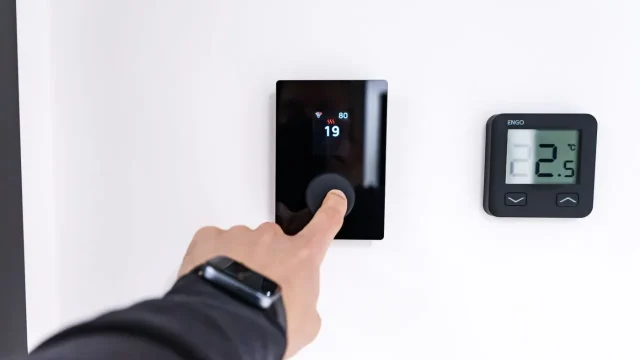
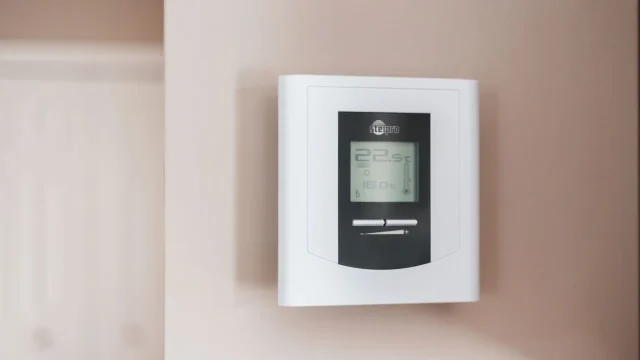
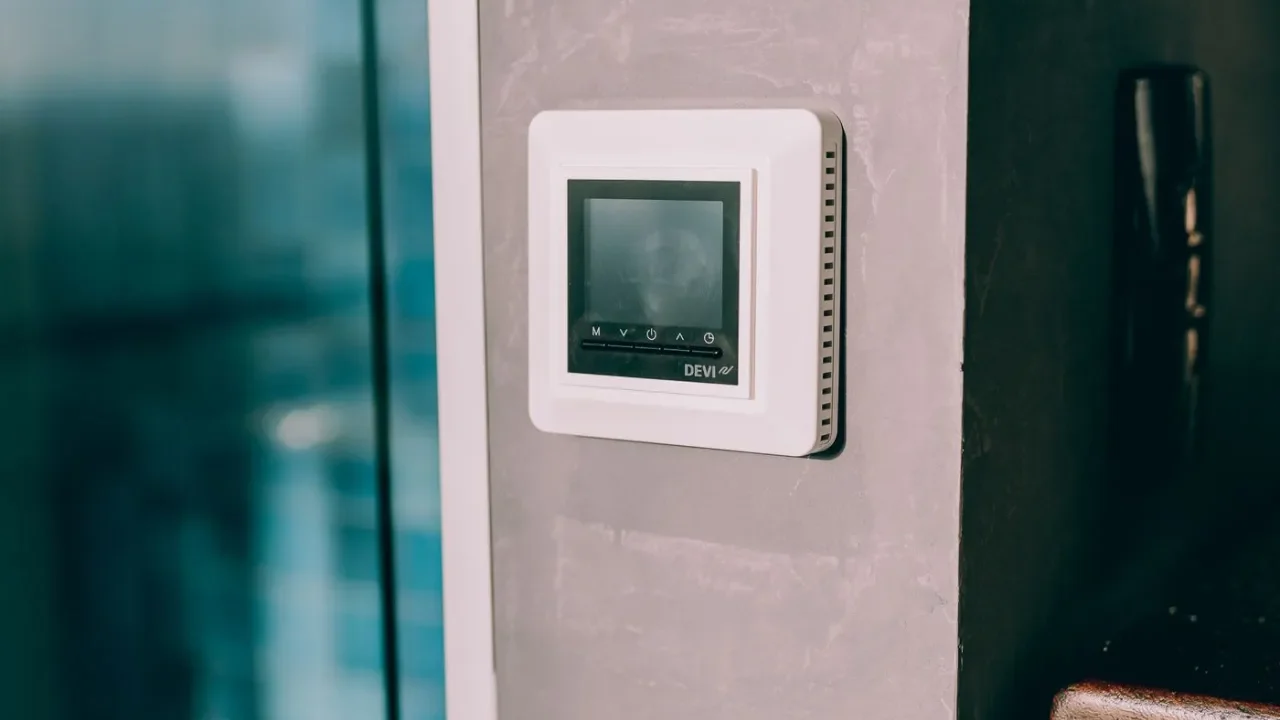
A thermostat is a control device. It has a temperature sensor, a set point you choose, and a switch. When the measured temperature drifts away from the set point, the thermostat turns the heating or cooling on; when it’s back on target, it turns it off.
A home wall thermostat, for example, is wired to your furnace, air conditioner or heat pump. Each wire carries a signal for one function. In Honeywell’s wiring guide for its Wi-Fi Smart Color Thermostat, W calls for heat, Y calls for the compressor (cooling), G runs the fan, and R and C supply 24 V power from the system’s transformer. Many thermostats are built into appliances instead: ovens, water heaters, refrigerators, irons and car cooling systems all use them.
Thermostats don’t switch on and off at exactly the set temperature. They allow a small band, called a differential or “swing,” to stop the system cycling constantly. Honeywell’s documentation for the same thermostat, for instance, describes a 1.5° differential before it changes over between heating and cooling.
Types of home thermostats
- Mechanical (non-programmable): a dial or lever, often using a bimetal strip.
- Digital programmable: you set a schedule, such as cooler at night and while you’re out.
- Smart (Wi-Fi): app control, alerts and, on some models, learning features, geofencing or remote room sensors.
- Line-voltage: for electric baseboard and wall heaters, which run on 120/240 V instead of the low-voltage (24 V) control used by most central systems.
For help choosing one, see our thermostat buying guide, Honeywell thermostat guide and ecobee vs Nest.
Why your thermostat and thermometer might disagree
It’s common for a wall thermostat to read a degree or two differently from a separate room thermometer. Usual causes:
- Location: a thermostat near a sunny window, a lamp, a kitchen, a supply vent or an outside wall reads differently from the middle of the room.
- Height: warm air rises, so a thermometer on a high shelf reads warmer than one at waist height.
- Accuracy tolerances: both devices have some margin of error.
- Response time: the two sensors may react to changes at different speeds.
To check, put a reliable thermometer next to the thermostat for 15–30 minutes and compare. Many digital thermostats let you apply a temperature offset in their settings. If your thermostat is badly placed, moving it or using a model with remote sensors may help. Our guide on how to calibrate a thermometer explains how to check a thermometer’s accuracy.
Do you need both?
Often, yes. A thermostat runs your heating and cooling, while separate thermometers do jobs a thermostat can’t:
- Checking food: only a food thermometer tells you whether meat has reached a safe internal temperature. See our safe cooking temperature chart.
- Checking appliances: fridge and oven thermostats can drift. A fridge thermometer confirms your refrigerator stays at or below 40°F, the FDA’s recommended maximum. See our fridge and freezer temperature guide.
- Monitoring other rooms: a room thermometer-hygrometer shows temperature and humidity where the thermostat isn’t, such as a nursery, basement or greenhouse.
Bottom line
A thermometer tells you the temperature; a thermostat uses the temperature to switch equipment on and off and hold your set point. Use a thermostat to control your home’s heating and cooling, and thermometers to check food, appliances and individual rooms.
FAQ
Is a thermostat a thermometer?
Not exactly. A thermostat contains a temperature sensor, so it measures temperature, but its purpose is to control a heating or cooling system. A thermometer only measures.
Can I use a thermometer instead of a thermostat?
No. A thermometer can’t switch your heating or cooling on or off. You need a thermostat for control.
Does an oven have a thermostat or a thermometer?
An oven has a thermostat that cycles the heating element to hold the temperature you set. Many cooks also use a separate oven thermometer to check that the oven is actually at that temperature.
Why does my thermostat show a different temperature than my thermometer?
Usually because of placement (sun, drafts, vents or height), small accuracy tolerances, or different response times. Compare them side by side, and use the thermostat’s offset setting if it has one.
What does “thermostat” mean?
It comes from Greek thermo (heat) and statos (standing), meaning something that keeps heat steady. “Thermometer” combines thermo with metron, meaning measure.
Sources: Honeywell Home Wi-Fi Smart Color Thermostat support documentation (wiring and auto-changeover details, via Manuals+); refrigerator temperature: FDA, Are You Storing Food Safely? Checked November 2026.