Editor’s note: Originally published April 2018. Reviewed and updated November 2026.
Quick answer
- Meat thermometers have a pointed probe for piercing meat and a lower range; many classic dial models top out around 200°F.
- Candy thermometers are long and blunt, read roughly 100°F to 400°F, and are made for hot sugar syrups and frying oil.
- They are not truly interchangeable: a candy thermometer won’t pierce meat, and a typical meat thermometer can’t read high enough for candy.
The main difference between a meat thermometer and a candy thermometer is temperature range and shape. A meat thermometer has a pointed probe and a lower range for checking the inside of meat. A candy thermometer is long and blunt, with a higher range for boiling sugar and hot oil.
Temperature matters with both. For meat, it decides both taste and food safety; for candy, it decides whether you end up with chewy caramel or hard brittle. Here is how the two compare and when, if ever, one can stand in for the other.
Meat thermometer vs candy thermometer at a glance
| Meat thermometer | Candy thermometer | |
|---|---|---|
| Typical range | Lower; many dial models up to about 200°F | About 100°F to 400°F |
| Shape | Short, pointed metal probe with a dial or display | Long and skinny, with readings along its length |
| Best for | Roasts, poultry, whole fish and other meats | Candy, caramel, sugar syrup, deep frying |
| Can it pierce meat? | Yes | No, the end is blunt |
| Reads candy temperatures? | Usually not high enough | Yes |
Meat thermometers
A classic meat thermometer has a pointed metal probe that you push into the meat, connected to a dial that shows the temperature. Many of these dial models read up to about 200°F, which covers the range you need for meat. Digital instant-read and leave-in probe thermometers work the same way, with a display instead of a dial.
They are useful for any kind of meat, including beef, pork, chicken, turkey and fish, and especially for large cuts where you can’t see whether the center is done, like roasts and whole fish.
Reaching a safe minimum internal temperature is essential, but going much higher than needed dries meat out. USDA recommends:
- Whole cuts of beef, pork, lamb and veal: 145°F, plus a 3-minute rest
- Fish: 145°F
- Ground meat: 160°F
- All poultry: 165°F
See our full chart of safe internal cooking temperatures, and browse our meat thermometer reviews if you need one.
Check your meat thermometer’s accuracy
It’s worth checking a meat thermometer before you rely on it. Put the probe in a glass packed with ice and topped with water; it should read 32°F. You can also check it in boiling water, which should read 212°F at sea level. If a dial thermometer is off, adjust the small calibration nut where the dial meets the probe. Our guide on how to calibrate a thermometer walks through both tests.
Candy thermometers
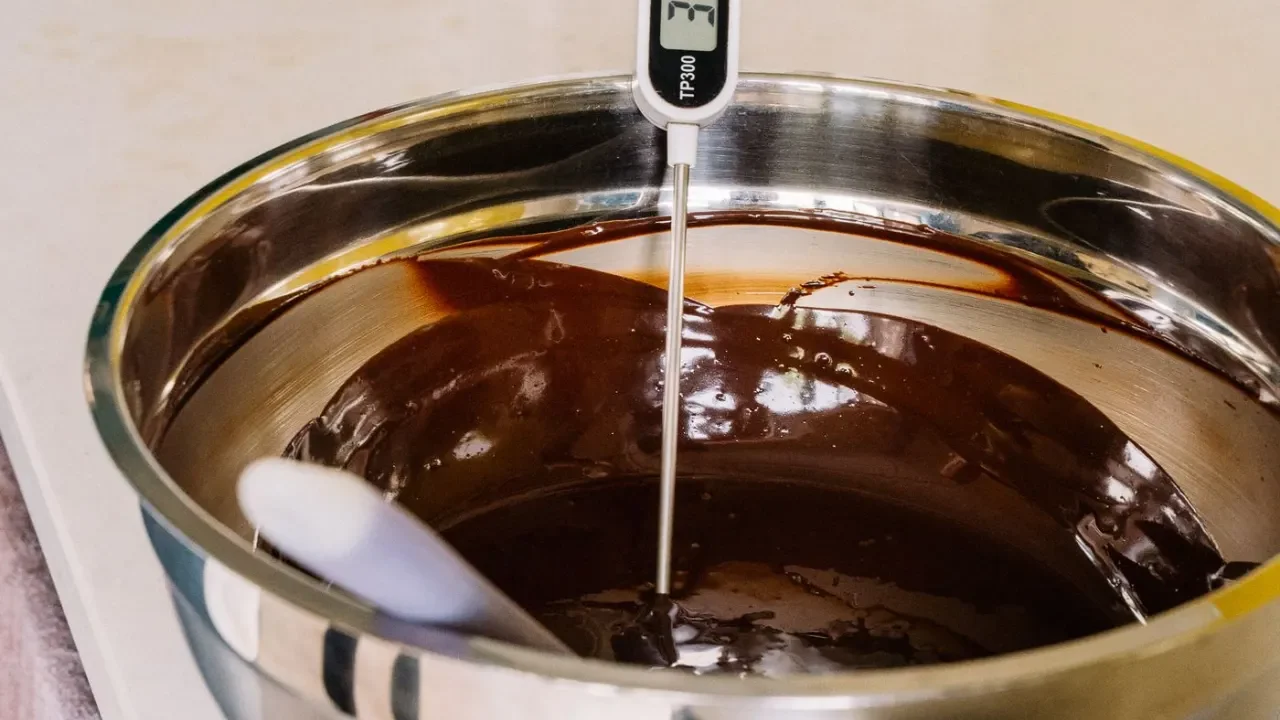
Candy thermometers can measure up to about 400°F. They are long and skinny, with readings along their length, so you can clip or stand them in hot liquid and read the temperature directly.
All candies are made by boiling sugar to a particular stage, from chewy to hard. That stage decides whether you get taffy, fudge, pralines or brittle, so an accurate candy thermometer is essential.
Candy thermometers are also handy for caramel sauce, sugar syrup and deep frying. Frying oil generally needs to be between 350°F and 375°F, and it is hard to judge by eye. Oil that is too cool makes food greasy because it absorbs oil; oil that is too hot burns the outside. See our candy thermometer reviews for options.
Can you use them interchangeably?
Not really. Each is designed for its own job, and neither works as well outside it.
- Candy thermometer for meat: the blunt end won’t pierce meat to reach the center, and it may be less accurate at lower temperatures because it is built for the high heat of candy-making.
- Meat thermometer for candy: most can’t read high enough for candy, and a short probe is less suited to measuring a pot of liquid than a long candy thermometer.
A candy thermometer can be used for anything liquid or soft enough to submerge it in, within its range of about 100°F to 400°F. If you would rather own one general-purpose thermometer for meat and other foods, choose one with a pointed probe and a wide enough range, and clean and sanitize it between uses. Our guide on how to clean a thermometer covers the basics.
Which should you choose?
- Mostly cook meat? Get a meat thermometer with a pointed probe.
- Make candy, caramel or fry often? Get a candy thermometer.
- Do both? Owning one of each is the simplest way to get accurate readings for both jobs.
Bottom line
Meat and candy thermometers differ in range and shape for good reason. Use a pointed meat thermometer to check that meat reaches a safe internal temperature, and a long, high-range candy thermometer for sugar work and frying.
FAQ
Can I use a meat thermometer for candy?
Usually not. Most meat thermometers can’t read the high temperatures candy needs, up to about 400°F.
Can I use a candy thermometer for meat?
It isn’t ideal. The blunt end won’t pierce meat to reach the center, and it may be less accurate at lower temperatures.
What temperature should oil be for deep frying?
Generally between 350°F and 375°F. A candy thermometer is a good way to check.